
Prototype: Synthetic Futures Canvas
An alternative to the Three Horizons framework that complicates the future

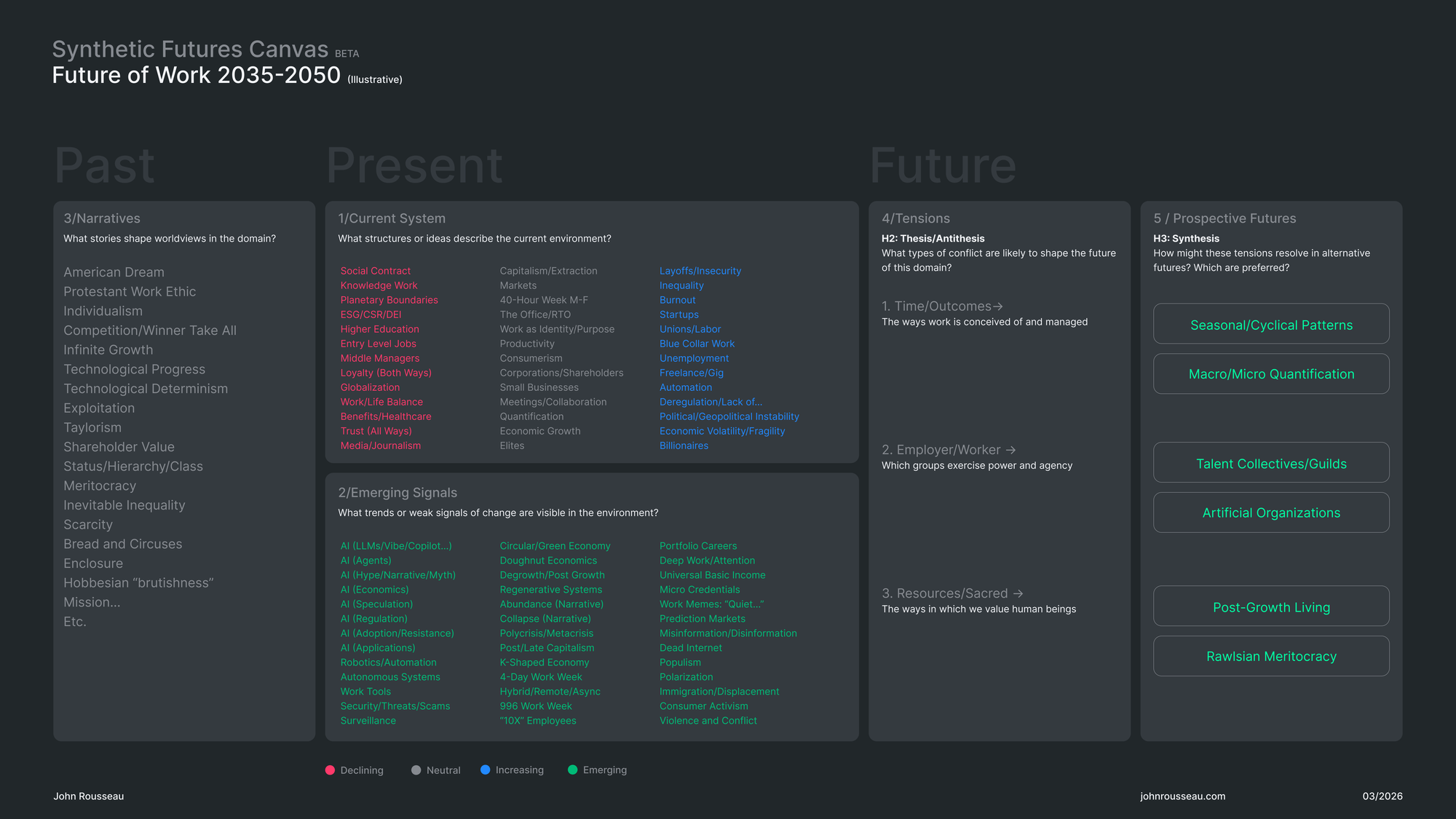
My first and most viewed piece since starting this blog in late 2023 was The Future of Work in Three Horizons. That post was more about introducing foresight in an approachable way than a comprehensive or serious analysis. For the sake of economy—so that I could explain the Three Horizons framework and bring it to life—I made specific but implicit assumptions about the nature and scope of work. For example, I focused on knowledge work in the context of Western capitalism, and stopped short of including signals from across all the topics that influence the domain.
I'm going to do the same thing here, this time with a new prototype that addresses certain limitations of Three Horizons, and that is oriented toward collaborative sense-making in complex environments. It would be suitable for a half-day or longer workshop—or as part of a conventional research or transformation program—and can be facilitated without extensive pre-work by participants.
This is an experiment in thinking in public—so it is presented as work in progress and only in brief. I plan to come back to the Future of Work regularly and will develop this framework and explore others along the way, adding depth and greater perspective to the analysis.
Some Limitations of Three Horizons
There are several things I like about Three Horizons. First is the emphasis on systems change over time, and the use of "H2-minus" and "H2-plus" to describe tensions in the second horizon that either reinforce or disrupt the dominant system on the way to H3, the future system. I explained the structure and mechanics of the framework in the previous post—so if you need a refresher you should start there.
I also appreciate how the framework creates a simple and compelling visual logic of decline, transition, and emergence, which requires little explanation and is an intuitive gateway into futures thinking. It is a reliable way to surface assumptions within a group, and can be done in a few hours.
This strength is also a limitation. The pattern flattens complex dynamics and suggests that change is both linear and coherently patterned within a grand narrative. In practice this leans toward superficial analysis and technocratic conclusions—for example that the current system is unfit for purpose (e.g., "regulation is stifling innovation") and that our job is to envision a preferable alternative (e.g., "abundance") and then create pathways via H2 to bring that future into being. It sounds compelling and makes for a good workshop, but underestimates the complexity of the environment and overestimates our agency to change it in predictable ways over long periods.
For more on how complexity requires a different approach, see my post Applied Foresight, Adaptive Strategy.
The Synthetic Futures Canvas (Beta)
If Three Horizons oversimplifies the future, what's needed is an approach that complicates our understanding—one that raises more questions than it answers and reveals rather than flattens complexity.
The reason this matters is that the goal is not to create a roadmap but rather to better attune stakeholders to emerging patterns of change and their role in the current system—so that they might approach adaptive strategic choices and actions in the present with a greater degree of self-knowledge and systemic understanding.
This tool—the Synthetic Futures Canvas—is proposed as a means of cultivating greater futures literacy and collective awareness within a group. It builds on foundations adapted from Three Horizons and Hegelian dialectics to bridge ideological and material theories of change. The name comes from Hegel—there is a thesis and an antithesis in conflict that resolve in a new synthesis. In the canvas, the Current System represents the thesis, Emerging Signals either perpetuate or challenge the thesis, and the Tensions section highlights the areas where these forces are in active conflict.
This approach emphasizes that futures emerge from the interaction of opposing forces, not from extrapolating trends or designing ideal endpoints. Change is synthetic in the Hegelian sense—new configurations emerge from contradictions in the present system. But unlike Hegel, there's no assumption of progress. The synthesis might be transformative, dystopian, or simply different.
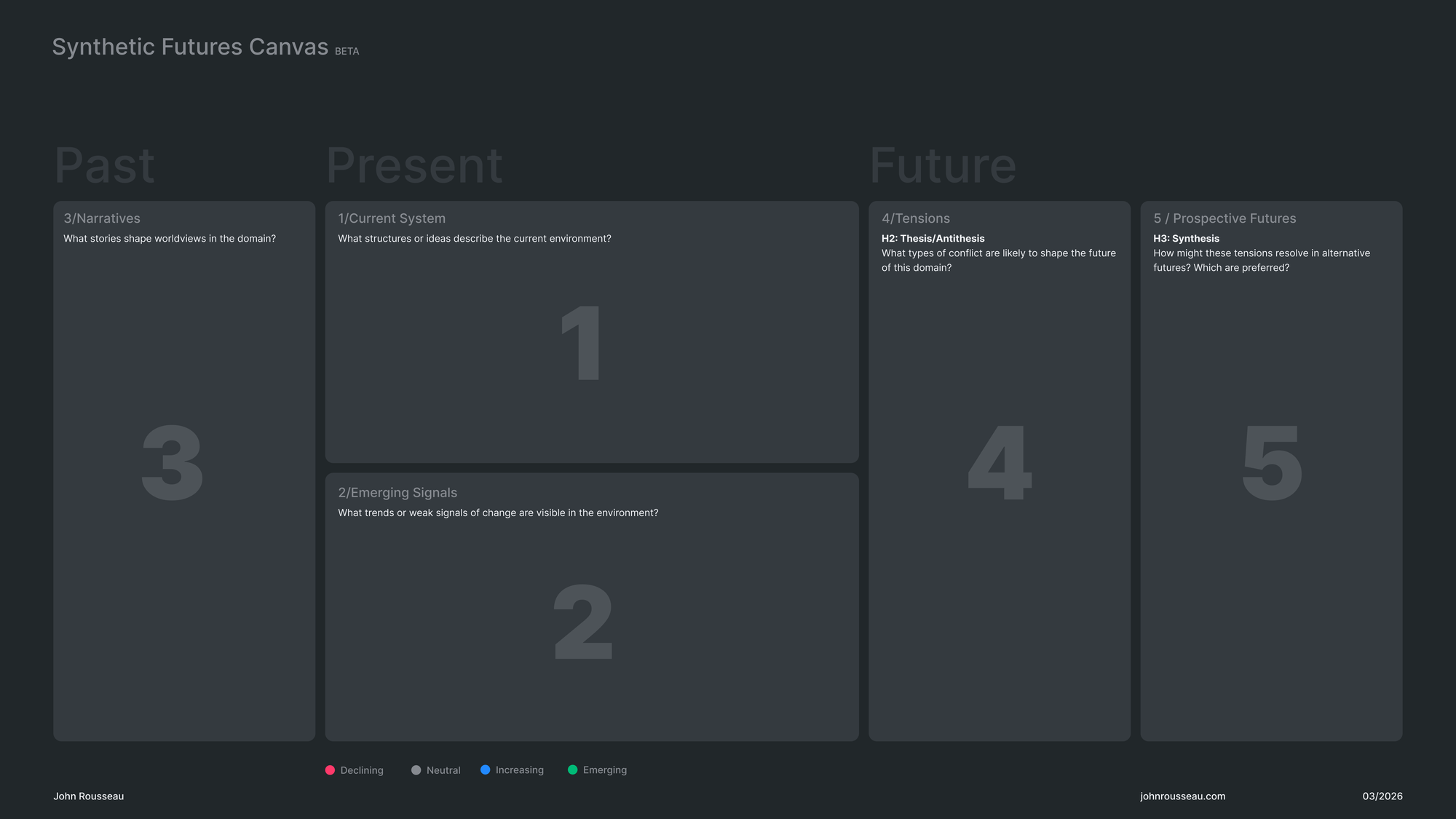
The parts of the canvas, in order of operation:
Understanding the Present
Current System: The ideas and structures of the present (declining/neutral/increasing)
Emerging Signals: Trends and weak signals in the current environment
Deconstructing the Past
Narratives: The deep stories and structures that shape our worldviews
Envisioning the Future
Tensions: Dialectics that are likely to shape the future (derived from parts 1-3)
Prospective Futures: The ways in which the thesis/antithesis resolve in alternative futures
In Practice
The process begins with mapping the present—identifying what is declining, neutral, or increasing within the current system alongside emerging signals of change. This surfaces assumptions and grounds the group in a shared reality before moving backward or forward.
Next, the group lists deep narratives relative to the domain. These are the invisible structures—economic models, cultural myths, institutional logics—that are inherited from the past and shape what futures we can even imagine. By making these explicit, the group can see what constraints are operating beneath the surface.
From there, dialectical tensions are generated. These aren't obvious polarities but rather fundamental conflicts between the dominant system (thesis) and emerging alternatives (antithesis). They represent areas of uncertainty where the future will be shaped by how these tensions resolve or fail to do so.
Finally, the group explores prospective futures by imagining possible syntheses. Each tension can generate varied pathways, and syntheses can combine across tensions. The group discusses which outcomes are preferred, though the goal isn't to choose a single future but rather to expand awareness across a range of possibilities and better align strategic choices and actions in the present.
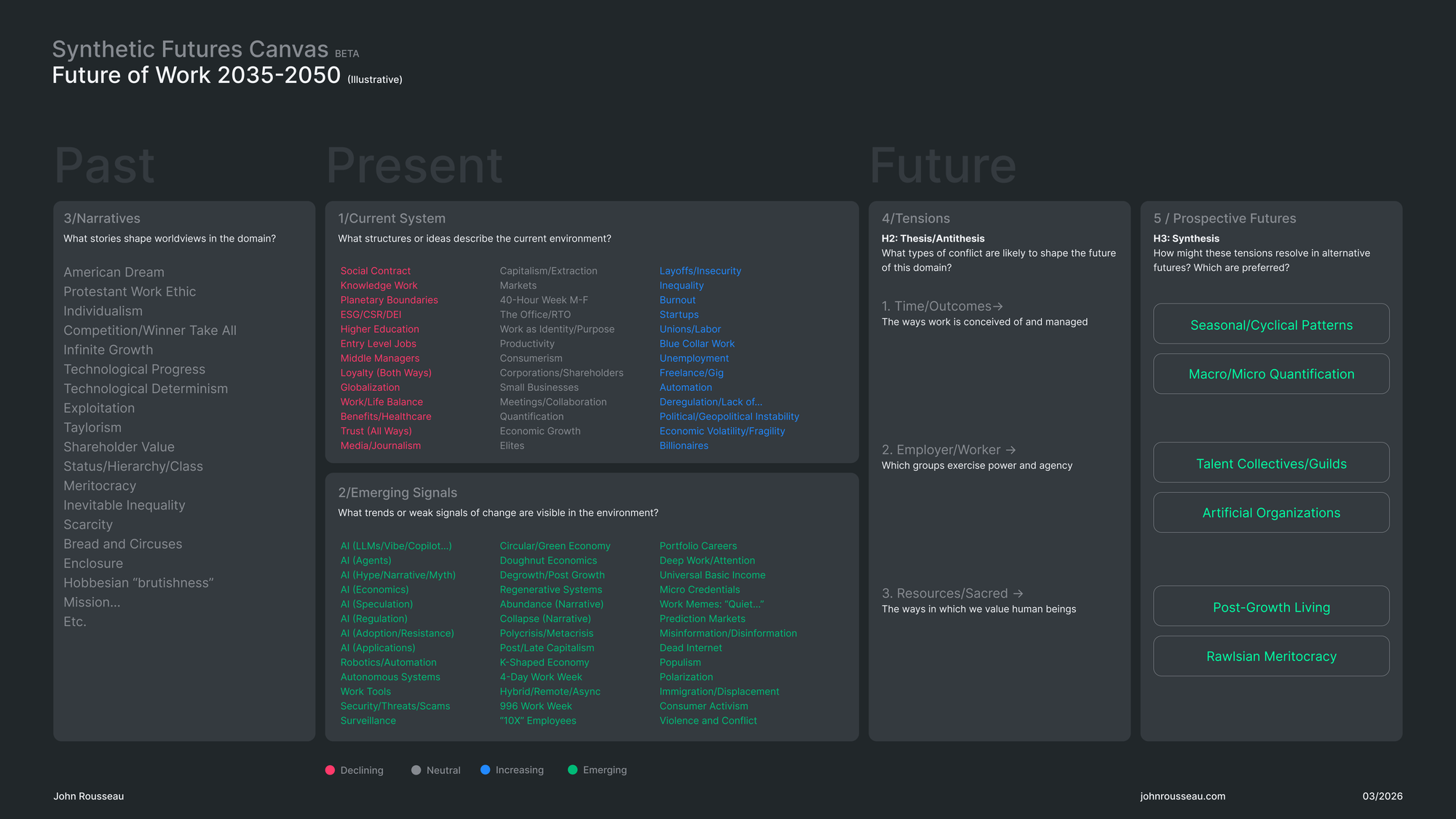
Complicating Past, Present, and Future
Where Three Horizons suggests a clear and coherent transition from H1 to H3, the Synthetic Futures Canvas foregrounds conflict, contradiction, and uncertainty. It doesn't produce a single future or theory of change. The canvas is designed for collaborative sense-making in conditions where the future is contested and where multiple perspectives need to be held simultaneously. It works best when the goal is adaptive capacity rather than strategic certainty.